Openai/69604fc9-2094-8011-b2ac-95f2a0167fff
This conversation was exported from ChatGPT[1]
gpt-5-2[edit | edit source]
User: "What is the distance to the nearest notable star vs the furthest notable star thats visible to the naked eye"[edit | edit source]
"What is the distance to the nearest notable star vs the furthest notable star thats visible to the naked eye"
Assistant: Great question—this really puts the scale of the universe into perspective 🌌[edit | edit source]
Great question—this really puts the scale of the universe into perspective 🌌
🌟 Nearest notable star (beyond the Sun)[edit | edit source]
Proxima Centauri[edit | edit source]
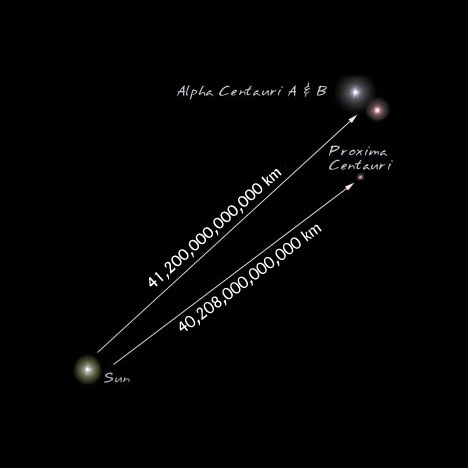
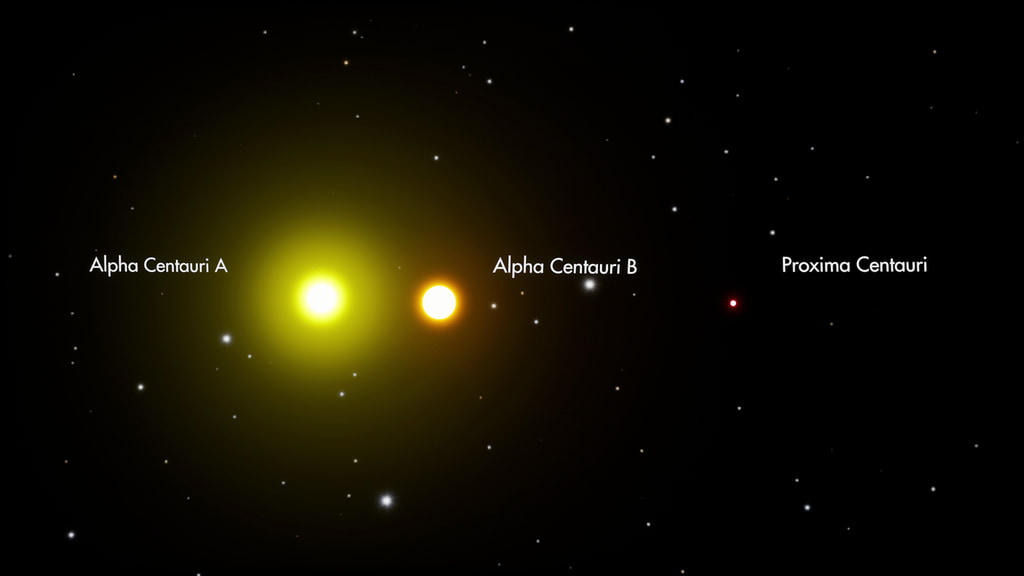
!https://imagine\.gsfc\.nasa\.gov/features/cosmic/images/nearest\_star\.jpg[2] !https://svs\.gsfc\.nasa\.gov/vis/a020000/a020300/a020377/Shot\_4\_Alternate\.00016\_print\.jpg[3]


- Distance: ~4.24 light-years
- Why it counts: It’s the closest star to our Solar System and part of the Alpha Centauri system.
- Visibility: ❌ Not visible to the naked eye (too dim)
So while it’s the nearest star, it’s not something you can actually see without a telescope.
👁️ Furthest notable star visible to the naked eye[edit | edit source]
V762 Cassiopeiae[edit | edit source]
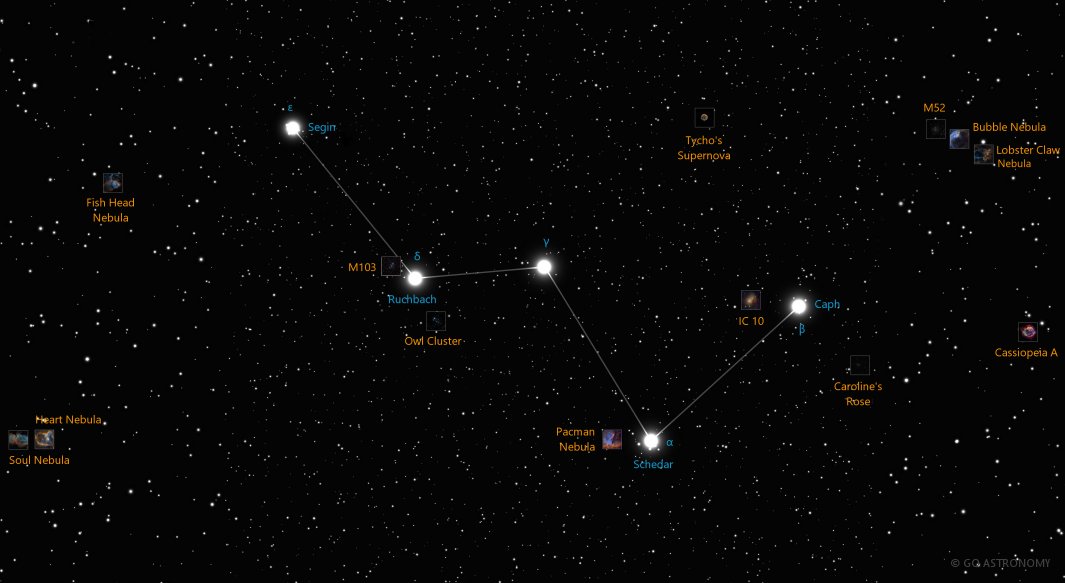
!https://upload\.wikimedia\.org/wikipedia/commons/7/7c/V762\_Cassiopeiae\.png[4] !https://www\.go\-astronomy\.com/images/constellations/Cassiopeia\.jpg[5]


- Distance: ~16,000 light-years
- Type: Red supergiant
- Why it’s visible: It’s absurdly luminous—hundreds of thousands of times brighter than the Sun.
Depending on atmospheric conditions and eyesight, this is generally considered the most distant individual star humans can see without optical aid.
🧠 Quick comparison[edit | edit source]
| Star | Distance | | ---------------- | ------------------- | | Proxima Centauri | 4.24 light-years | | V762 Cassiopeiae | ~16,000 light-years |
That means the furthest naked-eye star is roughly 3,700× farther away than the nearest star.
🤯 A fun extra mind-bender[edit | edit source]
- Everything you see with the naked eye is inside the Milky Way
- The Milky Way galaxy itself is visible to the naked eye… but it’s not a star—it’s a galaxy, stretching ~100,000 light-years across.
So:
- Nearest star: practically next door (cosmically)
- Furthest visible star: deep within our galaxy
- Beyond that: galaxies—visible, but no individual stars
If you want, I can also:
- Compare this to sci-fi travel times 🚀
- Explain why brightness matters more than distance
- Or show how many naked-eye stars fall into different distance bands
User: Not that you should but isnt our sun the closest star that we can see with the naked eye or is the qualifier notable ha…[edit | edit source]
Not that you should but isnt our sun the closest star that we can see with the naked eye or is the qualifier notable having you ignore that in favour of the others?
Assistant: Yep — you’re absolutely right 👍[edit | edit source]
Yep — you’re absolutely right 👍 And your instinct about the qualifier is exactly on point.
Short answer[edit | edit source]
The Sun is the closest star visible to the naked eye. By a ridiculous margin. Nothing else even comes close.
Why people (including me earlier) usually exclude it[edit | edit source]
It’s mostly a convention, not a technicality.
When astronomers or science explainers say “nearest star”, they almost always mean:
- Nearest star other than the Sun
The Sun gets quietly excluded because:
- It’s trivially obvious (it’s literally defining our reference point)
- Including it makes the comparison boring: - Sun: ~8 light-minutes - Next star: 4.24 light-years
- Discussions are usually about stellar neighbors, not our own star
So yes — “notable” was doing a bit of social work there, nudging the Sun out of the room so the comparison stayed interesting.
If we’re being pedantic (and we should be 😄)[edit | edit source]
| Category | Winner | | -------------------------------------- | ------------------------ | | Closest star, period | The Sun | | Closest star besides the Sun | Proxima Centauri | | Brightest star in our sky | The Sun | | Closest naked-eye star besides the Sun | Alpha Centauri A | | Furthest naked-eye star | ~15–16k light-years away |
A fun perspective shift[edit | edit source]
If you didn’t exclude the Sun, the scale jump becomes insane:
- Sun → Proxima Centauri ≈ 63,000× farther
- That’s like: - Earth → Moon vs - Earth → halfway to Alpha Centauri 🚀
So: You were correct, your reasoning was solid, and yes — the Sun gets excluded purely for conversational sanity, not because it doesn’t qualify.
If you want, we can:
- Redo the whole comparison including the Sun for full cosmic absurdity
- Talk about why Alpha Centauri barely counts as naked-eye
- Or compare this to sci-fi “warp speed” travel times 😏
References[edit | edit source]
- ↑ "Nearest vs Furthest Star". ChatGPT. Retrieved 2026-01-09.
- ↑ "https://imagine\.gsfc\.nasa\.gov/features/cosmic/images/nearest\_star\.jpg". imagine.gsfc.nasa.gov. Retrieved 2026-01-09.
{{cite web}}: External link in|title= - ↑ "https://svs\.gsfc\.nasa\.gov/vis/a020000/a020300/a020377/Shot\_4\_Alternate\.00016\_print\.jpg". svs.gsfc.nasa.gov. Retrieved 2026-01-09.
{{cite web}}: External link in|title= - ↑ "https://upload\.wikimedia\.org/wikipedia/commons/7/7c/V762\_Cassiopeiae\.png". upload.wikimedia.org. Retrieved 2026-01-09.
{{cite web}}: External link in|title= - ↑ "https://www\.go\-astronomy\.com/images/constellations/Cassiopeia\.jpg". go-astronomy.com. Retrieved 2026-01-09.
{{cite web}}: External link in|title=