Openai/69590395-0448-8008-a9cf-189d43182e3b
This conversation was exported from ChatGPT[1]
gpt-5-2[edit | edit source]
User: what do you know about the us and venezuela?[edit | edit source]
what do you know about the us and venezuela?
Assistant: The relationship between the United States and Venezuela is a long, complicated mix of cooperation, conflict, ideology,…[edit | edit source]
The relationship between the United States and Venezuela is a long, complicated mix of cooperation, conflict, ideology, and oil politics. Here’s a clear, structured overview—historical, political, economic, and where things stand today.
###[edit | edit source]
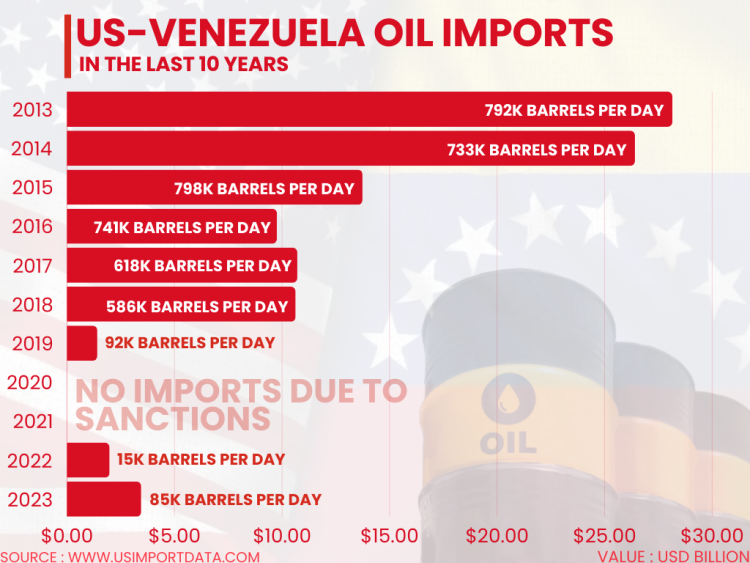
!https://upload\.wikimedia\.org/wikipedia/commons/5/55/Venezuela\_historic\_inflation\_index\_and\_oil\_revenue\.png[2] !https://www\.usimportdata\.com/blogs/uploads/images/202412/image\_750x\_6752cd205b3b1\.png[3] !https://cdn\.britannica\.com/76/72976\-138\-55EFC1D3/Caracas\-Venezuela\.jpg[4]


- For much of the 20th century, relations were pragmatic and cooperative.
- Venezuela was: - One of the world’s major oil exporters - A stable democracy (after 1958) - A key supplier of oil to the US
- US companies (Exxon, Chevron, etc.) had major investments in Venezuelan oil.
In short: oil + anti-communist alignment = good relations.
!https://i\.guim\.co\.uk/img/static/sys\-images/Guardian/Pix/pictures/2006/09/21/chavezUNchom\_372\.jpg?crop=none&dpr=1&s=none&width=465[5][edit | edit source]

!https://www\.gainesville\.com/gcdn/authoring/2007/11/17/NTGS/ghows\-LK\-717c4cde\-9a4b\-46e6\-b192\-ba46797d0699\-da380531\.jpeg?auto=webp&disable=upscale&format=pjpg&width=1200[6] !https://cdnuploads\.aa\.com\.tr/uploads/Contents/2019/02/02/thumbs\_b\_c\_6bf49567e3c2f9d2f42986bb98d58566\.jpg?v=225900[7]


- Hugo Chávez came to power in 1999.
- He launched the “Bolivarian Revolution”: - Socialist ideology - Strong anti-US rhetoric - Nationalization of oil and key industries
- Chávez positioned Venezuela as: - A leader of anti-US, anti-imperialist politics - Ally of Cuba, Iran, Russia, China
US perspective:
- Concern over: - Democratic backsliding - Nationalization of US assets - Regional influence against US interests
From here on, relations steadily deteriorated.
!https://npr\.brightspotcdn\.com/dims4/default/303672e/2147483647/strip/true/crop/5422x3615%2B0%2B0/resize/880x587%21/quality/90/?url=http%3A%2F%2Fnpr\-brightspot\.s3\.amazonaws\.com%2F71%2F9a%2Fa8c6c6574b78bfdffe90c42bc10a%2Faptopix\-venezuela\-maduro\-rally\-25344723501248\.jpg[8][edit | edit source]

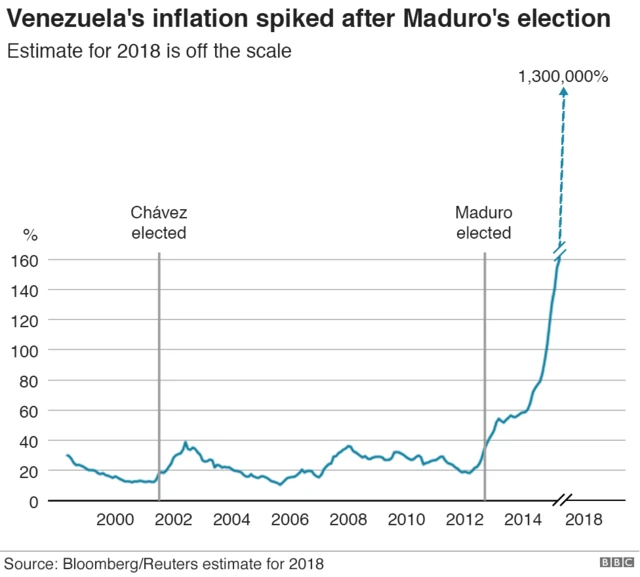
!https://ichef\.bbci\.co\.uk/ace/ws/640/cpsprodpb/7822/production/\_105345703\_venezuela\-inflation\_v3\_976\-nc\.png\.webp[9] !https://www\.brookings\.edu/wp\-content/uploads/2018/04/global\_venezuelanrefugees\_colombianborder\.jpg[10]


- After Chávez’s death, Nicolás Maduro took over.
- Venezuela experienced: - Economic collapse (hyperinflation, shortages) - Mass emigration (7–8 million people) - Accusations of authoritarianism and electoral fraud
US response:
- Sanctions on: - Venezuelan oil - State institutions - Key individuals
- Recognition (2019) of opposition leader Juan Guaidó as interim president (no longer active now)
Venezuela’s response:
- Deeper ties with Russia, China, Iran
- Framing the crisis as US economic warfare
!https://www\.chevron\.com/\-/media/chevron/worldwide/images/updated\_venuzuela\_hero\_img\.jpg?h=882&hash=A78EC32E7DB94D5B26250EE05311D493&la=en&w=1568[11][edit | edit source]

!https://www\.miamiherald\.com/public/latest\-news/na3su5/picture299541614/alternates/LANDSCAPE\_1140/Richard%20Grenell%20at%20Miraflores\.jpg[12] !https://cdn\.cfr\.org/sites/default/files/styles/immersive\_image\_3\_2\_desktop\_2x/public/image/2019/01/Opec\.webp[13]


Despite hostile rhetoric, reality is more nuanced:
- US sanctions hurt Venezuela badly, but: - Internal mismanagement and corruption were also central causes
- After Russia’s invasion of Ukraine, the US: - Quietly allowed limited oil cooperation - Gave Chevron partial licenses to operate in Venezuela
- The US goal shifted from “regime change” to: - Preventing humanitarian collapse - Managing migration - Stabilizing oil markets
So the relationship today is hostile in principle, pragmatic in practice.
US view of Venezuela[edit | edit source]
- An authoritarian state
- A source of: - Regional instability - Migration pressure - Influence from US rivals (Russia, China)
Venezuelan government view of the US
- An imperial power
- Responsible for: - Sanctions - Economic hardship - Attempts to overthrow the government
Both narratives contain partial truths.
- This is not just a bilateral dispute.[edit | edit source]
- It sits at the intersection of: - Energy politics - Ideology (socialism vs liberal democracy) - Global power competition
- Neither side fully trusts the other, but neither can completely disengage.
If you’d like, I can:
- Compare Venezuela with Cuba or Iran in US foreign policy
- Explain sanctions mechanics in plain terms
- Discuss whether Venezuela could realistically recover—and under what conditions
- Frame this from a global South or non-US-centric perspective
Just tell me which angle you’re curious about.
User: What can ousting of maduro help the us stance economially and politically?[edit | edit source]
What can ousting of maduro help the us stance economially and politically?
Assistant: Ousting Nicolás Maduro could theoretically help the United States in several economic and political ways—but it’s impor…[edit | edit source]
Ousting Nicolás Maduro could theoretically help the United States in several economic and political ways—but it’s important to separate potential benefits, realistic limits, and risks. I’ll be frank and non-romantic about it.
1. Economic implications for the US[edit | edit source]
✅ What the US could gain[edit | edit source]
- Oil market access and stability
- Venezuela has the world’s largest proven oil reserves.
- A post-Maduro government acceptable to Washington would likely: - Reopen fully to US companies (Chevron, Exxon, service firms) - Restore Venezuelan production over time
- This would: - Add non-Russian, non-Middle Eastern supply - Reduce global price volatility - Strengthen US energy security indirectly
Reality check: This would take years, not months. Venezuela’s infrastructure is badly damaged.
- Reduced sanctions-management costs
- Sanctions are expensive to enforce diplomatically and administratively.
- A friendly government would allow: - Removal of oil and financial sanctions - Normal banking and trade channels
- That benefits US firms and financial institutions.
- Migration pressure
- Venezuela’s collapse has sent millions of migrants across the region, some to the US.
- Economic recovery under a new government could: - Slow outbound migration - Reduce US domestic political pressure on immigration
❌ What the US would not gain[edit | edit source]
- Venezuela would not suddenly become an oil bonanza for the US.
- China and Russia would not disappear from Venezuela overnight.
- Oil prices would still be influenced mainly by OPEC+ and global demand.
2. Political and strategic implications[edit | edit source]
✅ Strategic advantages[edit | edit source]
- Symbolic win for US democracy promotion
- Removing Maduro would be seen (in Washington) as: - A rollback of authoritarian socialism in the hemisphere - A counterexample to Cuba-style endurance
- This matters especially in US domestic politics and foreign-policy signaling.
- Reduced influence of US rivals
Maduro is closely aligned with:
- Russia (security, oil)
- China (debt, infrastructure)
- Iran (sanctions evasion)
A new government would likely:
- Rebalance away from these actors
- Reduce their strategic foothold in the Americas
- Regional diplomatic reset
- Latin American governments are divided on Venezuela.
- A credible transition could: - Reduce regional polarization - Improve US relations with moderate governments in the region
❌ Political limits[edit | edit source]
- US credibility is mixed in Latin America due to: - Past interventions - Sanctions harming civilians
- Any government seen as “installed by the US” would face legitimacy problems.
- Nationalism would still constrain close alignment with Washington.
3. The biggest risks for the US[edit | edit source]
⚠️ 1. Chaos instead of transition[edit | edit source]
- Ousting Maduro without a strong institutional plan could produce: - Power vacuum - Military fragmentation - Competing armed groups This would be worse for US interests than the status quo.
⚠️ 2. Anti-US backlash[edit | edit source]
- Many Venezuelans oppose Maduro and distrust the US.
- If sanctions are remembered more than relief, resentment could persist.
⚠️ 3. Setting a precedent[edit | edit source]
- Regime change narratives weaken US arguments elsewhere: - Against Russia (Ukraine) - Against China (Taiwan, Hong Kong)
- It complicates the global norm of sovereignty.
4. Bottom line (plain assessment)[edit | edit source]
From a US perspective:
- Economically → moderate long-term upside
- Politically → symbolically significant but operationally limited
- Strategically → useful only if stable, legitimate, and gradual
The uncomfortable truth: For the US, a slow normalization under negotiated reforms may be better than a dramatic ousting that risks instability.
That is why current US policy quietly leans toward:
- Conditional sanctions relief
- Negotiated elections
- Managed coexistence, not invasion or abrupt regime change
If you want, next we could explore:
- Why regime change worked in some cases (e.g. Eastern Europe) but not others
- Whether Venezuela is closer to Iran, Cuba, or Myanmar as a case
- How China would actually respond to a post-Maduro Venezuela
- Or assess this from a global South / non-US lens
Just point me to the angle you care about most.
References[edit | edit source]
- ↑ "US Venezuela Relations". ChatGPT. Retrieved 2026-01-04.
- ↑ "https://upload\.wikimedia\.org/wikipedia/commons/5/55/Venezuela\_historic\_inflation\_index\_and\_oil\_revenue\.png". upload.wikimedia.org. Retrieved 2026-01-04.
{{cite web}}: External link in|title= - ↑ "https://www\.usimportdata\.com/blogs/uploads/images/202412/image\_750x\_6752cd205b3b1\.png". usimportdata.com. Retrieved 2026-01-04.
{{cite web}}: External link in|title= - ↑ "https://cdn\.britannica\.com/76/72976\-138\-55EFC1D3/Caracas\-Venezuela\.jpg". cdn.britannica.com. Retrieved 2026-01-04.
{{cite web}}: External link in|title= - ↑ "https://i\.guim\.co\.uk/img/static/sys\-images/Guardian/Pix/pictures/2006/09/21/chavezUNchom\_372\.jpg?crop=none&dpr=1&s=none&width=465". i.guim.co.uk. 2006-09-21. Retrieved 2026-01-04.
{{cite web}}: External link in|title= - ↑ "https://www\.gainesville\.com/gcdn/authoring/2007/11/17/NTGS/ghows\-LK\-717c4cde\-9a4b\-46e6\-b192\-ba46797d0699\-da380531\.jpeg?auto=webp&disable=upscale&format=pjpg&width=1200". images.openai.com. Retrieved 2026-01-04.
{{cite web}}: External link in|title= - ↑ "https://cdnuploads\.aa\.com\.tr/uploads/Contents/2019/02/02/thumbs\_b\_c\_6bf49567e3c2f9d2f42986bb98d58566\.jpg?v=225900". cdnuploads.aa.com.tr. 2019-02-02. Retrieved 2026-01-04.
{{cite web}}: External link in|title= - ↑ "https://npr\.brightspotcdn\.com/dims4/default/303672e/2147483647/strip/true/crop/5422x3615%2B0%2B0/resize/880x587%21/quality/90/?url=http%3A%2F%2Fnpr\-brightspot\.s3\.amazonaws\.com%2F71%2F9a%2Fa8c6c6574b78bfdffe90c42bc10a%2Faptopix\-venezuela\-maduro\-rally\-25344723501248\.jpg". npr.brightspotcdn.com. Retrieved 2026-01-04.
{{cite web}}: External link in|title= - ↑ "https://ichef\.bbci\.co\.uk/ace/ws/640/cpsprodpb/7822/production/\_105345703\_venezuela\-inflation\_v3\_976\-nc\.png\.webp". ichef.bbci.co.uk. Retrieved 2026-01-04.
{{cite web}}: External link in|title= - ↑ "https://www\.brookings\.edu/wp\-content/uploads/2018/04/global\_venezuelanrefugees\_colombianborder\.jpg". tse2.mm.bing.net. Retrieved 2026-01-04.
{{cite web}}: External link in|title= - ↑ "https://www\.chevron\.com/\-/media/chevron/worldwide/images/updated\_venuzuela\_hero\_img\.jpg?h=882&hash=A78EC32E7DB94D5B26250EE05311D493&la=en&w=1568". chevron.com. Retrieved 2026-01-04.
{{cite web}}: External link in|title= - ↑ "https://www\.miamiherald\.com/public/latest\-news/na3su5/picture299541614/alternates/LANDSCAPE\_1140/Richard%20Grenell%20at%20Miraflores\.jpg". miamiherald.com. Retrieved 2026-01-04.
{{cite web}}: External link in|title= - ↑ "https://cdn\.cfr\.org/sites/default/files/styles/immersive\_image\_3\_2\_desktop\_2x/public/image/2019/01/Opec\.webp". images.openai.com. Retrieved 2026-01-04.
{{cite web}}: External link in|title=